My Virtual Placement Experience With Public Health England
Hey there, I hope you enjoy this read.
My name is Treasa Fitzgerald, a student occupational therapist from the University of Lincoln. Like most universities I’ve had an opportunity to complete a role emerging placement. For anyone who is curious about what that entails, it involves working in an organisation where, in my case, occupational therapists are not well established. This was also a 100% virtual placement. OH YAHH, wait for it, I got to work with Public Health England.
What can I say, I landed on my feet with this one. Linda Hindle (Deputy Chief AHP Officer for England) was my placement mentor, she kept me on the straight and narrow and couldn’t have been more supportive. She reminded me that perfectionism is not pivotal, but determination, and the willingness to learn and develop as a student AHP is. I’d love to say I get things right first time but I’m sure other students in particular will resonate when I say it’s a slower process, you keep chipping away. The real secret is to keep up with your reflections, it’s the best tool for self-directed learning. Sometimes there’s that lightbulb moment when you’re out on placement (fireworks going off in your brain). But most of the time you keep slogging away, and eventually bing bing bing, it all comes together.
I didn’t work with PHE alone though, Leah Holloway and I were together on this one, (thank you Leah for all the chats and laughs and genuine kindness, you’re a golden nugget). So, where do I start. Let me take you through my experience week by week, we’ve been busy bees, and I hope that the more I share the more you’ll consider taking up opportunities to jump at virtual placements like this one.

Week 1:
On Tuesday morning the 1st of September, Leah and I had a really exciting conversation with Linda Hindle, deputy chief officer for England. She explained what was in store for us, and we dived into every opportunity to develop our skillset and engaged with several different project teams.
I was beaming with excitement, and I probably had one too many coffees because my eyes could have popped out of my head. Poor Leah had to listen to all my brainwaves for the rest of the day, bless her.

The first thing we started to converse about and prepare for was our AHPs4PH twitter account takeover. We were tasked with thinking about content that would appeal to students. We had a unique opportunity to share our own thoughts, tips, tricks and resources that could help others along their educational journeys. We eventually came to the conclusion that we needed to keep things real. On a personal level, Leah and I felt discussing topics “kindness, honesty, self-esteem, and the imposter syndrome” could really benefit our target group. We agreed that always trying to paint the perfect picture, or fit in, or achieve as much as everyone else, from an external viewpoint, is really difficult, especially when you are starting out/or restarting with new career prospects.
The reality is, we (most students) are at one stage or another overwhelmed by what we may not already know, and feel like we should know and sometimes our own lack of self-acceptance. It’s difficult to feel as though you fit in to this societal norm. Julie Walters our wonderful, inspiring long armed (university) supervisor, sparked a thought during our first supervision on the importance of considering these topics and a general theme of discussion for our social media takeover, both Leah and I concurred.

Besides getting the opportunity to meet other key AHP public health advocates, and joining in on team meetings, Leah and I started planning for our sustainability project regarding the use of equipment. Plaguing people for information on their return of equipment policies, seeking key performance indicators, I felt like a bit of a detective. We tirelessly searched for answers about the revolving issue around well conditioned mobility equipment being disposed of, and potential solutions to resolve this crisis. Understanding how to provide more person-centred care and approaches to ensure a greener future for the NHS was a priority of ours (we had a long way to go at this stage but we were committed to find answers). I can only speak for myself here, but the kindness from the team and tweets of recognition at the end of week 1 made my head swell, I said to myself, sweet serotonin, I’ve got this.
Week 2:
On monday the 7th of September, I opted for a green tea, no eye popping caffeine buzz that morning. I got straight down to business. We (Leah and I) decided to circulate our thoughts for the content takeover, we needed to choose a theme. Of course, we all know what it’s like to multitask, trying to juggle absolutely everything and not always getting it right. We all need to take a step back and pause every now and again and just let our river flow. I don’t mean this in a sense of going to the toilet or any of that personal business, moreso in reference to the KAWA river model about letting life take its course and doing your best to keep on track, and to breakdown those barriers (those rocks and driftwood in the river that get in your way). On a serious note, we wanted to ensure that we were going to make use of our valuable time during takeover week, to share and re-share information that people could resonate with. I would be happy if for every resource shared, 1 person gained, and so I prepared.
Wait till I tell you about the Jamboard session I attended. Sorry, I’m going to be hoping from topic this week but I’m telling you it’s a good one to know about. The topic was mental health and wellbeing of students in ambulance service training/professionals. This is an interactive means of compiling thoughts/options. Google created this whiteboard, I’m not tech savvy but I have to say it’s not difficult to use, and super effective (thinking about leadership roles in the future? have a look at jamboard @ https://edu.google.com/products/jamboard/?modal_active=none.
Did you ever hear of a physical activity clinical champion? I’ll hold my hand up and say I hadn’t until Friday the 11th of september. In summary, you as a student/AHP professional can attend one session, via zoom to improve your knowledge on how to motivate people to keep active. For moderate exercise what does that involve do you think? The message of the day was “you should be able to talk, not sing”. This was another fantastic discussion, about movement and motivation. We all know it’s not easy for people to feel like exercising and let’s be honest we are coming into winter, it’s going to be cold and dark. The thought of hitting the road running doesn’t sound too enticing, or going for an evening swim. Anyone else shouting “Excuses, excuses”? Or “thanks, but no thanks”. That’s normal. But we can all do a little more to improve our activity levels i.e. why not offer to clean up after tea? It’s not easy to make these commitments. Setting shorter, more achievable goals can make everything and anything, within reason possible.
I was the endorphin queen at the start of the pandemic, thanks to the daily body coach workouts. But I’ve also had my ups and downs and inconsistencies. You need to feel ready, motivated to change, to push the body a little more. This training provides support for professionals who can help turn their own thoughts into realities and also guide patients who are committed to change. The thing is, public health is everyone’s responsibility, a diamond of a placement, I must say.
Week 3:
Seen as I like to share what I have to drink the start of every week, I think I will continue this trend. On the 13th September, I had water and a dash of lime. I was parched with the thirst, therefore I avoided caffeine at all cost. I was pondering over thoughts about our takeover week which was fast approaching, trying to think of something unique I could bring to the table. Let me take a step back and explain. Leah and I had a discussion with Julie our university supervisor the previous Friday. She advised us to use the health and wellbeing student takeover week as an opportunity to be pro-active, and to try and meet the needs of individuals without being too forceful and demanding in our requests. Leah and I agreed, If you are trying to improve someone’s mental health status, the last think you want to do is come across forceful; avoid saying you should do this, that and the other. We had other plans, creative plans, and so I wrote a poem (I’m no William Wordsworth).
To ask open questions- enables others to inform
Identifying values and priorities, the motivation drivers to which we perform
Facilitating behavioural changes, moving away from the current “norm”
Through goal setting, prioritization and empowerment, we can prevail and transform
How do we motivate someone to change their behaviours? The one size fits all does not work, how could it? Some of us are cheesy for example (ME). However motivational interviewing allows the individual you are supporting to take control. We can all practice a bit of motivational interviewing in our day to day lives.

Below is a list of both formal and informal questions created in collaboration with Leah and Julie.
Formal style sample questions:
Tell me about those activities/occupations that are meaningful to you?
With your values and priorities in mind, what would you like to be able to do more of? Do your behaviours currently facilitate/inhibit you?
What would enable you to make those changes? Who could offer support?
What are the pro’s and con’s that might encourage/discourage this change process?
Informal:
What floats your boat?
What makes you get up in the morning?
What gives your life meaning and value?
Before I die, I want to…
What makes you feel hopeful?
One think I’ve loved about working with Linda (@HindleLinda) and (@PHE_UK) is how caring and kind the team have been. Leah and I have been working on a document for paramedic students and other members of the ambulance service to encourage discussions about wellbeing and self-management. We like to call it the “wellbeing toolkit”. It will contain questions that require individuals to consider both internal and external factors that will influence their wellbeing. They have such faith in us and this has really helped to boost my confidence and develop skills to advocate for improved public health.
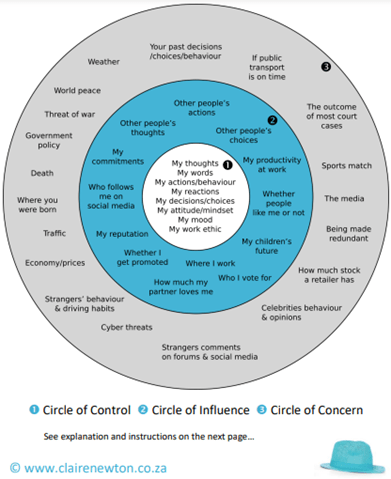
Anyone ever hear of the “circle of control, influence and concern”. This resource is fantastic to help you focus on the things you can do something about, this was a fantastic resource I learned about during my first placement. This model was originally developed by Stephen Covey and has since been adapted and shared online by Sarah Newton, she also has printable blank circles if you want to visit her website @ http://www.clairenewton.co.za/my-articles/circles-of-control.html
Takeover (week 4):
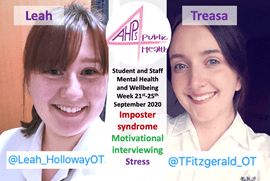
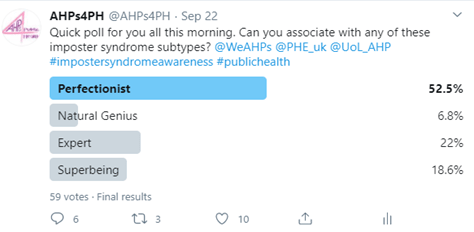
I’m going to skip the usual drink introduction and provide insight into one of our topics from our AHPs4PH takeover “imposter syndrome”. It’s important for all of us to realise our unique talents, our differences are what makes the world go round. Do you ever get that sinking feeling in your stomach where you don’t feel you’re good enough? or if something is not completed at a high standard you perceive it as failure?, as though nothing short of perfection is acceptable? Ever feel consumed by self-doubt? Well lets familiarise ourselves with the imposter syndrome subtypes and see, can you associate with any of the following?
A. Perfectionist – Competence is only achieved through perfection, any shortcoming is perceived as failure
B. Natural genius – Measures competency by the ease of which an achievement is obtained, success should come naturally in your eyes.
C. Expert – Measures competence by your overall amount of knowledge or skill, you fear being viewed as inexperienced.
D. Superbeing – Perceives competence to be a good multitasker. Faltering in even one of your roles will result in perceived failure
The results below illustrated that over half of our 59 votes favoured option A: Perfectionist, we are incredible hard on ourselves, and for what reasons? We set our standards too high.
The reality is, we are all fantastic on numerous levels, and it’s important to reflect on how far we have come.
My advice is: Acknowledge your achievements. Even the small ones. Daily, weekly, monthly and yearly. That’s one of the pivotal things I’ve learned throughout my occupational therapy training, from my fantastic lecturers at the University of Lincoln, along with placement experiences. The advice I can give is to look after yourself and allow time for self-care, do what makes you happy, and grab hold of every learning opportunity along the way. You will be surprised how beneficial your input will be seen to be in the varied organisations you will encounter. I believe that health and social care students need to hear this in particular
Week 5:
Back to my favourite this week, coffee, but with a bit of maple syrup to sweeten me up. I know its an unusual combination, but I prefer it to sugar so don’t judge. During the week, I finalised a piece for the MSc newsletter for the university of Lincoln with the support of my wonderful supervisor Julie Walters.
The focus this week is going to be on another topic from our takeover for that reason. Being openly vulnerable is a difficult task, but a worthy consideration. The results from our twitter poll below highlighted that less than 70 percent of our 22 voters favoured options B or C, meaning they were unsure of, or would disagree that it is worth the risk of disclosing their vulnerable self to a trusted colleague.
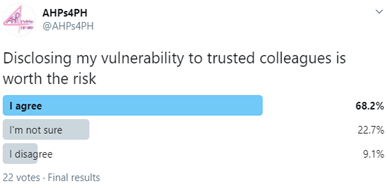
These are very interesting findings, and I would reflect that being able to be vulnerable and acknowledge when you feel unsure or have slipped up, really is a powerful imposter syndrome buster. It does need to be to someone you trust, a loved one, friend or colleague. After all, a problem shared is a problem halved. I hope that you can find that support in your evolving journey as a health and social care professional.
Week 6:
If you made it this far thank you so much! Anyone interested in boiling the kettle for me? My coffee is a bit strong, and sweet. I’m after mis-judging the proportion of coffee and syrup (which I have decided to have for two consecutive Mondays), and I was doing so well with spicing things up every other week, you can’t beat the basics though.

As I have completed my placement, I think it is important to summarise some of our project work:
Sustainability project (mobility/ living aids):
- Based on the equipment providers I have spoken to, most aim to recycle >80% of mobility/living aids based on value.
- Some providers physically inspect equipment based on costs >200
- Cost effectiveness, the ability to deep clean and acceptability by customers are key considerations when considering the disposal of/recycling capabilities of equipment
- WHO released a document specifying a priority list of equipment required in low income countries including information regarding living/mobility equipment https://www.who.int/phi/implementation/assistive_technology/low_res_english.pdf
- NRS Clinical have shown through their donation of equipment no longer required by local commissioners how they are striving to meet sustainable development goals.
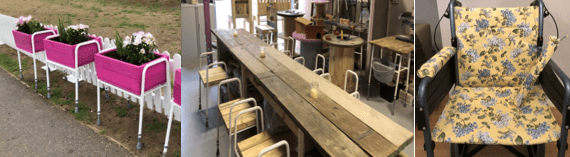
- Paula Massey has initiated an upcycling service in Wales. She decided to become more involved in sustainability work after spending a period of time in hospital (where she noticed problems with the lack of equipment re-used/recycled). As a result of caring for her mother she began to personalise pieces of equipment to improve their overall appearance. Below I have attached some images of her fantastic work, and provided a link to her website.
Wellbeing toolkit:
Leah took lead on this, check out her blog: https://leahhollowayroleemerging.wordpress.com/blog/
Leahs fantastic work led to the continuation of this document which hopefully will be published in the near future.
Blog:
Thank you so much for reading, I hope to be back in the near future. Slán (bye).
 Treasa Fitzgerald (Occupational Therapy Student)